
See? A Perfect Tree
Stephen Sondheim, E.B. White, and Turtle Bay Gardens
A guest essay by Sam Berit
In Sunday in the Park with George, a fictionalized Georges Seurat assures his apprehensive mother, “Pretty isn’t beautiful, Mother, / Pretty is what changes. / What the eye arranges / Is what is beautiful.”
Apply this wisdom to the evolving oasis of New York City known as Turtle Bay Gardens and watch the farmland of the 1700s give way to the private neighborhood enclave outlined by 20 townhouses on East 48th and 49th Street. The actual garden of Turtle Bay Gardens, made available only to residents of the townhouse perimeter, has offered a dose of greenery amidst concrete to numerous artists over the years. This list includes Katherine Hepburn, Bob Dylan, Mary Martin, Tallulah Bankhead, Dorothy Thompson, and two men of particular interest: composer and lyricist Stephen Sondheim and author and essayist E.B. White.
Thank you for reading! Upgrade to a premium subscription for full access to The Sondheim Hub: an exclusive essay, crossword, extended interview & more each week, plus our complete, paywall-free library of 200+ essays, features & interviews.
In 1930, Stephen Sondheim, in his first year of life, was already taking root in New York City’s history—becoming one of the first residents of the iconic, twin-towered apartment building on Central Park West: The San Remo. Born the only child of dress house owner Herbert Sondheim and dress house chief designer Janet “Foxy” Sondheim, Stephen enjoyed a lavish childhood, lacking only his parents’ attention but ultimately bypassing loneliness through a rigorous playdate schedule, as explained to biographer Meryle Secrest: “It wasn’t that I thought ‘oh, I wish I could be with mommy and daddy’. I loved running around the park, you know, looking for clues and doing chasing games. I thought it was swell!” As can be intuited, Sondheim was a bright child who learned to read phonetically at an early age, demonstrating his abilities by reading The New York Times aloud to his first grade class. Music predictably filled Sondheim’s home, either in solitude from his beloved Capehart record player or in company from his father’s self-taught piano performances—until one night the swan song of his parents’ marriage finally played.
Sondheim, following two years at the New York Military Academy and in the aftermath of his parents’ messy divorce settlement, relocated to Doylestown, Pennsylvania with his mother. Conveniently, about four miles away from Sondheim’s new Bucks County address lived the Hammerstein family. As Sondheim said in most every interview, osmosing himself into the home of famed Broadway lyricist Oscar Hammerstein II bent the trajectory of his life into the shape we recognize today. Sondheim’s closeness to Hammerstein as a paternal figure ignited his natural curiosity and talent for the theatre—and served as his first notable brush with proximity to inspiration.
In 1899, 31 years before Sondheim made Earth’s company, another individual with the gift of the pen was born: Elwyn Brooks White entered the world anxious and introspective, the youngest of six children. E.B.’s father, Samuel White, worked as vice president for a piano manufacturing company and E.B.’s mother, Jessie White, stayed home to care for the bunch. The White family lived as a contained unit, nestled atop Chester Hill in a sophisticated pocket of Mount Vernon, New York—boasting a 25-minute train ride to Grand Central station. Jessie White prioritized family time and was reluctant to embrace community, as E.B. explained in a letter to publishing executive Cass Canfield:
For the first eighteen years of my life I never even knew there was such a thing as a dinner party. Nobody got into our fashionable house unless he was kinfolks, and even then he had to beat his way in. I might as well have been living in the Rain Forest.
While White’s extensive and insulated family time contrasted that of Sondheim’s childhood, both boys undoubtedly possessed a penchant for activity and a sharp intellect. White enjoyed, more than anything else, spending time outdoors biking, canoeing, and skating; captivated by the inherent rhythm of nature and the creatures that inhabit it. Similar to Sondheim’s introduction to reading, White’s brother Stanley taught E.B. how to read phonetically using The New York Times, catalyzing White’s adolescent success in writing.
Both White and Sondheim attended prestigious schools to pursue higher education: White studied English at Cornell University and Sondheim studied music at Williams College; and, after graduating, both found their way back to New York City by way of their respective parents’ homes. White was struggling to both find and keep a job in a 1921 post-World War I Manhattan and commuted to the city daily from his parents’ Mount Vernon residence to endure the struggle. Sondheim, on the other hand, won the Hutchinson Prize in 1950 that offered him a two-year long fellowship to study music in the city—necessitating a two-year long residence on his father and stepmother’s sleeper sofa at 1010 Fifth Avenue, directly facing the Metropolitan Museum of Art. For some months thereafter, the winds of youth briefly pushed White and Sondheim out West to pursue varied work opportunities—in journalism and television, respectively—enabling both to return home with a redefined commitment to making life work in New York City.
Upon returning to the Big Apple, both young men were soon on the precipice of finding the work they would pursue for the rest of their lives. White was living at 112 West 13th Street in 1925 while working part-time at an ad agency and contributing several pieces to The New Yorker in its inaugural year; and, exactly 30 years later, Sondheim was living in a brownstone at 11 East 80th Street while toiling away on the lyrics for West Side Story. Both men were recalibrating their expectations of the work they hoped to do, finding their professional footing, and learning how their words could mold their lives—all in service of their city’s renowned institutions. They were pulling New York City closer and, perhaps in return, New York City was expanding outward for them like the sea. By the time White reclined into a full-time Staff Writer role at The New Yorker and Sondheim digested the success of his second Broadway show Gypsy, their next move became clear: Turtle Bay Gardens.
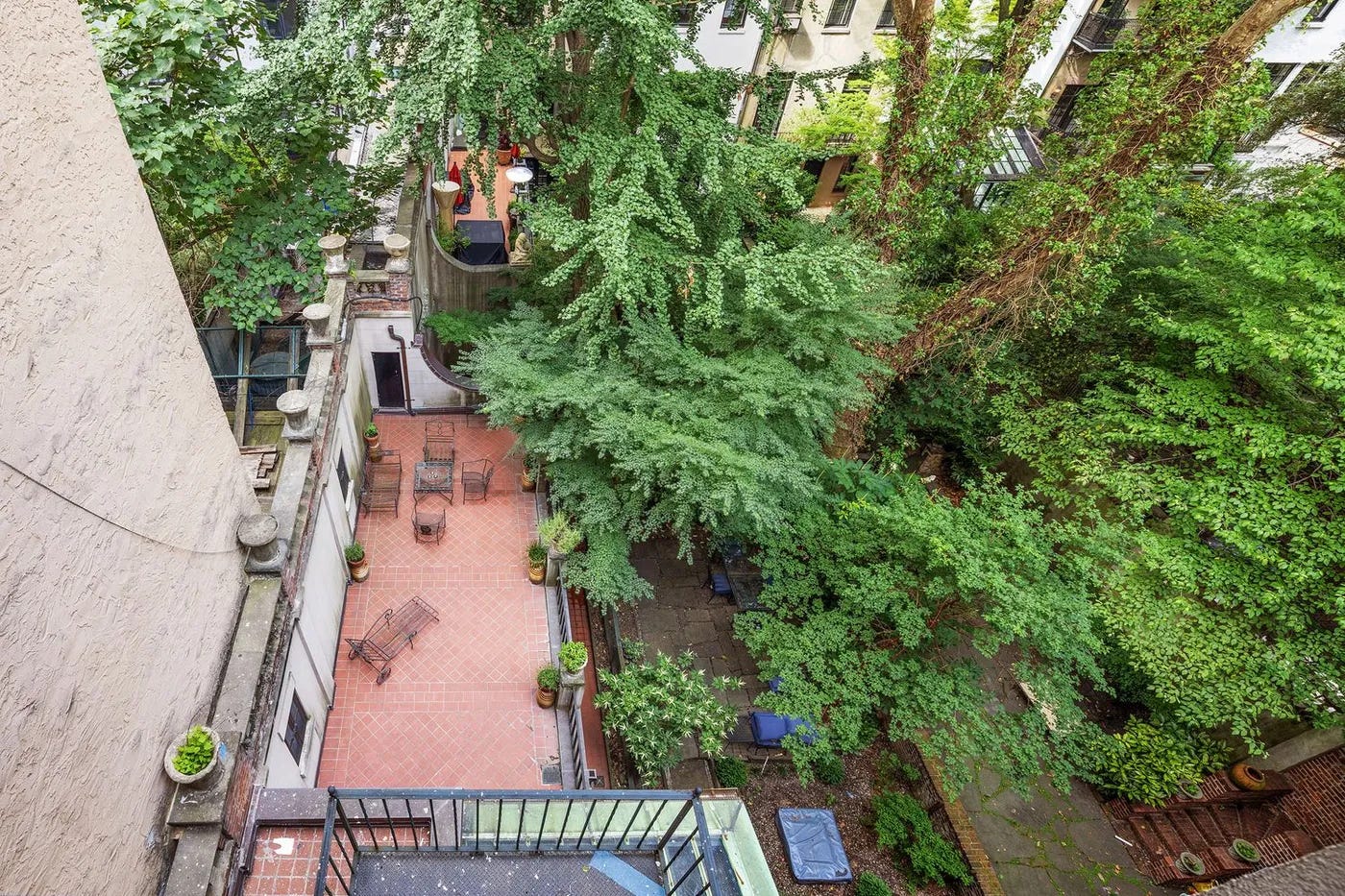
If, at this point, White’s and Sondheim’s paths seem like two parallel lines, Turtle Bay Gardens skews them perpendicular—despite no overlap in residence. White lived at various addresses on East 48th Street on and off until 1957 and Sondheim firmly planted roots at 246 East 49th Street in 1960. Both men wrote much of their most acclaimed work during their time at Turtle Bay Gardens. This shared history invites inspection, a closer look at the adjacencies across their writing as well as their ideologies on the craft.
The abundant connections between White’s and Sondheim’s work seem to originate from a shared ethos on the arts. White, in one of his earliest submissions to The New Yorker, defined a theatre critic:
The critic leaves at curtain fall
To find, in starting to review it,
He scarcely knew the play at all
For watching his reaction to it.
Sondheim, in his essay “Critics and their Uses” (in Finishing the Hat), comes to a similar conclusion: “Newspaper reviewers in particular have limited time to think about what they’ve witnessed, to consider the work at hand. They are of necessity drive-by shooters.” White and Sondheim’s skepticism also emerged in the face of the dreaded career award. In 1978, White received a Pulitzer Prize Special Citation that celebrated his entire body of work up to that point—to which White responded, “I guess they’re trying to catch up on things. They think time is running out.” Sondheim, in similar fashion, expressed his unsmiling opinion in an essay “Awards and their Uselessness” (in Look, I Made a Hat):
For the awardee, the most depressing among them [awards] is the Lifetime Achievement, which signifies one more nail in his coffin. It denotes the slippage from respect into veneration. In my blacker moments, I think of it as the Thanks-a-Lot-and-Out-with-the-Garbage Award.
Beyond an icier perception of their industries, White and Sondheim’s shared warmth emanated from the same sacred text: The Elements of Style by William Strunk Jr.
White once affectionately referred to his former Cornell professor’s 1918 style guide for The New Yorker as “a summation of the case for clearness, accuracy, and brevity in the use of English.” In 1959, White revised the handbook himself emphasizing the value of writing for one’s own approval above all else. In a grand literary crossing of paths, Sondheim was one of the many inspired by this revised publication and credits the book for informing his own artistic commandments as outlined in Finishing the Hat:
There are only three principles necessary for a lyric writer, all of them familiar truisms. They were not immediately apparent to me when I started writing, but have come into focus via Oscar Hammerstein’s tutoring, Strunk and White’s huge little book The Elements of Style, and my own sixty-some years of practicing the craft…In no particular order, and to be written in stone: content dictates form; less is more; God is in the details—all in the service of clarity, without which nothing else matters.
Yes. Sondheim was a fan of White’s work—so much so that he once lauded White in an interview with Frank Rich for The New York Times: “Once a line becomes poetry, it’s not a lyric. Reduction releases power. E.B. White may be my favorite American writer because of that.”
One of White’s most prominent gifts was his ability to examine the magic of nature and apply those findings plainly to his writing. He frequently penned essays about his barn in Allen Cove, Maine, and he wrote about the imagined dynamics of animal life in his children’s book Charlotte’s Web:
The Barn was very large. It was very old. It smelled of hay and it smelled of manure. It smelled of the perspiration of tired horses and the wonderful sweet breath of patient cows. It often had a sort of peaceful smell—as though nothing bad could happen ever again in the world.
White’s potent love for the natural world expressed across his writing resembles the work of Sondheim’s old neighbor and mentor, Oscar Hammerstein II. The man who distilled the enchantment of life into the single lyric:
All the cattle are standin’ like statues.
Despite Sondheim’s admiration for the song “Oh, What a Beautiful Mornin’” and even deeper admiration for Hammerstein himself, he openly criticized his mentor’s dependence on nature-oriented lyricism across his shows, once commenting in an interview with composer and lyricist Adam Guettel:
There’s a lot about Oscar’s lyrics that I find wet and embarrassing…that kind of nature imagery makes me cringe…you think that everybody in all of his shows are nature lovers. They all sound alike. They’re always talking about willow trees and birds and rivers.
The bucolic sameness that Sondheim believed Hammerstein relied on could have been, to some degree, directed at White as well. However, White had a knack for recontextualizing his specific understanding of nature in the more broadly shared reality of his readers—tethering, for instance, the image of a slumping willow tree (no bird nor river made the cut) to the world’s most famous urban jungle.
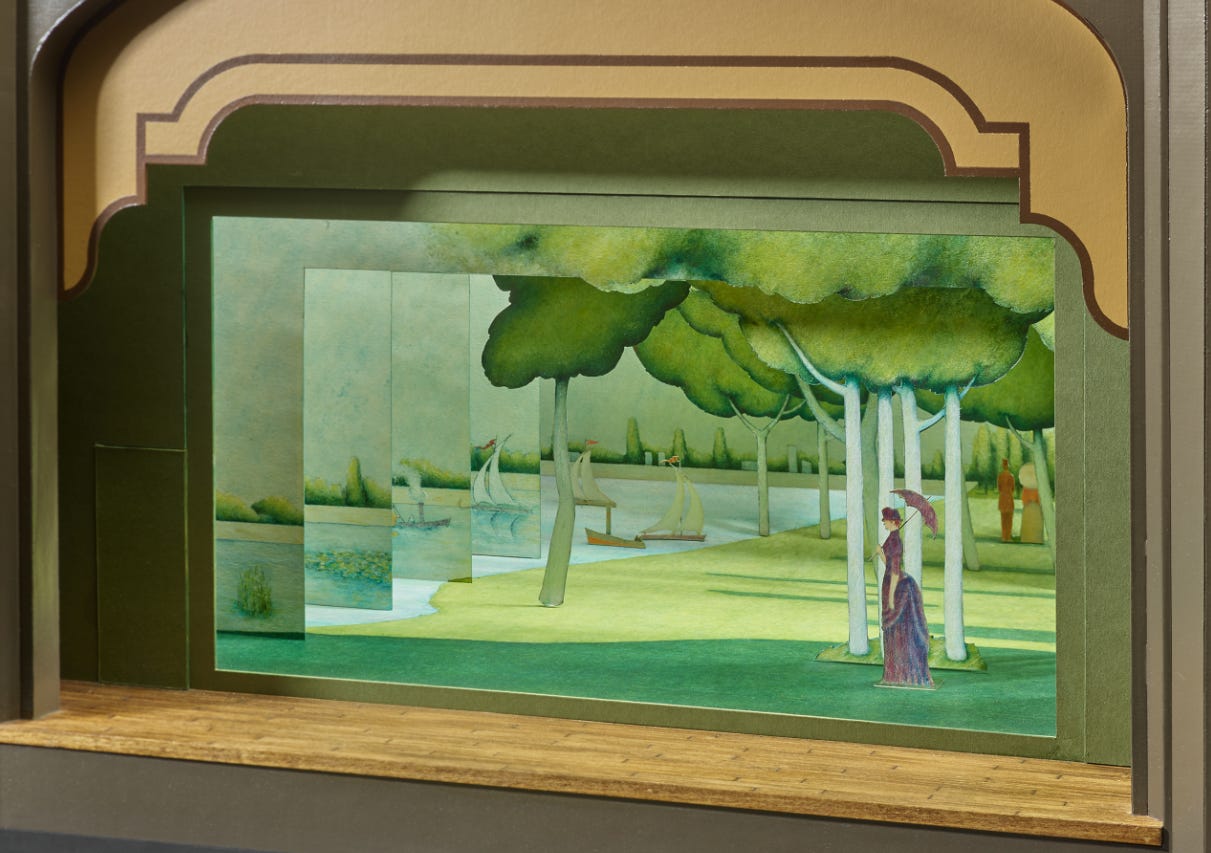
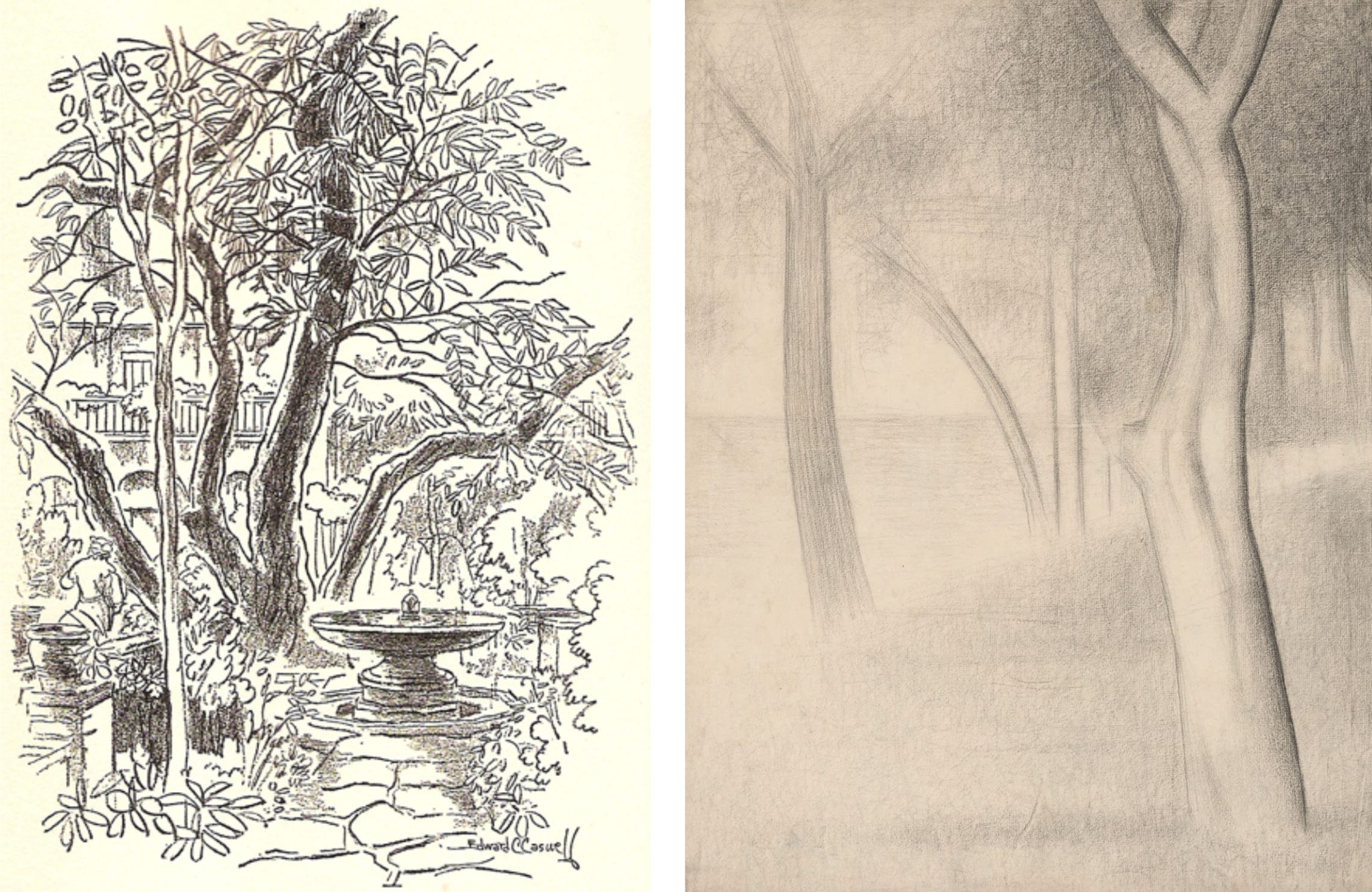
Here is New York stands tall as one of White’s most cherished essays. Originally published in Holiday magazine in 1949, Here is New York unfurls New York City and dissects the main players, the pulse points of activity, and the still fixtures that hold it together and upright. The essay goes wide and gradually narrows, resulting in a final paragraph that equates the city’s existence to a willow tree residing in Turtle Bay Gardens. It is an essay that feels close in heart to Sondheim’s 1984 musical, Sunday in the Park with George. The show delivers a first act that unveils Seurat’s A Sunday Afternoon on the Island of La Grande Jatte—layering the painted characters’ storylines atop each other’s until the masterpiece reaches completion. New York City and A Sunday Afternoon present a feast of visual grandeur, outlines that convey shared humanity. However, both White and Sondheim blotted out the whole to find the same focal point in their frenetic subject matter: the single tree.
Sondheim, in the interview with Guettel, said that he wrote most of Sunday on his Turtle Bay terrace overlooking the garden. Seldom had Sondheim admitted to writing anywhere other than his own couch before, making the garden a more intentional backdrop for work on this specific musical—one that casts the subtle flicker of Hammerstein’s influence. It was there that Sondheim distinguished the Old Lady from the Nurse and the Boatman from the Soldiers, just as White wrote of “the gladiator, the evangelist, the promoter, the actor, the trader, and the merchant” all wedged together in the “compact arena” of the city. It was there that Sondheim imagined the fate of those immortalized in paint, “And furthermore, / Finding you’re / Fading / Is very degrading. / And God, I am so hot!”, just as White considered the immortality of New Yorkers:
I am probably occupying the very room that any number of exalted and some-wise memorable characters sat in, some of them on hot, breathless afternoons, lovely and private and full of their own sense of emanations from without.
But, perhaps most saliently, it was there that Sondheim gave a command through character:
Notice every tree—
The single tree functions as a mirror throughout Sunday, reflecting the characters’ feelings back to them. It is an obstruction to some, a refuge from heat to others—but it mainly serves as the consequence of attention. To notice the tree is to notice the fluctuations of life, what is living and what is dead. In the Act I song “Beautiful”, the Old Lady shares her fears for the future with her son, “Changing. / It keeps changing. / I see towers / Where there were trees.” And in the Act II song “Lesson #8”, an adrift George, the great great grandson of the Old Lady, visits the same park and grapples with the outcome of those very fears: “See George attempting to see a connection / When all he can see / Is maybe a tree.” The tree, withstanding one hundred years of life and one hundred years of life on canvas since the Old Lady ached, plays a crucial part of Sunday in both acts and symbolizes a lesson imparted throughout the show—look closely.
The garden of Turtle Bay Gardens has held the eyes of many. It has offered a verdant break from the gray, geometric storm of the city it resides within—and, it has offered one special tree. White, at the end of Here is New York, wrote of it:
A block or two west of the new City of Man in Turtle Bay there is an old willow tree that presides over an interior garden. It is a battered tree, long suffering and much climbed, held together by strands of wire but beloved of those who know it. In a way it symbolizes the city: life under difficulties, growth against odds, sap-rise in the midst of concrete, and the steady reaching for the sun. Whenever I look at it nowadays, and feel the cold shadow of the planes, I think: “This must be saved, this particular thing, this very tree.” If it were to go, all would go—this city, this mischievous and marvelous monument which not to look upon would be like death.
Is it possible that White and Sondheim were looking at the same tree all those years apart? Were their paths always leading to this specific garden, to this specific tree? When reading Here is New York or watching Sunday, there is a feeling of inevitability present—they had to exist and they will go on. Both works were born of the same view and remain anchored above time, hovering in an untouchable space. Sondheim aptly put it in words:
As we pass
Through arrangements of shadows
Towards the verticals of trees
Forever…
This was the beauty of the old willow tree—now gone from Turtle Bay Gardens, now gone from New York City. Just like E.B. White and Stephen Sondheim. The two navigated similar lives that ultimately led to this shared vantage point, yet they wrote what only they could. The work that outlives them reminds us that one need not stray far to find inspiration as many stories can spring loose from the sight of a tree, alone—such as this one. Returning to George’s earnest words, “See? / A perfect tree.” There are surely many other perfect trees, perfect streams, perfect skies dotted throughout this planet, inviting those only with the capacity to truly see to go forth with the right story—but there will never be this one again.
Last year, Sam wrote for DC Theater Arts about Into the Woods, the Kennedy Center, and the severe moment we find ourselves in. To read that essay, click here.
✍️ Please support our work by upgrading to a premium subscription:
The Sondheim Hub exists solely thanks to the generous support of our readers. Please consider supporting our work for a few dollars each month. A premium subscription gives you full access to The Sondheim Hub: an exclusive essay, crossword, extended interview & more each week, plus our complete, paywall-free library of 200+ essays, features & interviews. 📚
I love this piece so much.
amazing work drawing the links between Sondheim and White both logistically (so many cool coincidences) and thematically!